ARTHUR DOVE at AUCTION

BIOGRAPHY

Arthur Dove was one of the first American artists to experiment with complete abstraction. His unique, nature-inspired style developed independently from his modernist contemporaries, and his thematic concerns remained remarkably consistent throughout his life.

Dove was born in the Finger Lakes region of New York State, where his father was a brickyard owner and building contractor. He displayed an early interest in art and received his first painting lessons from a neighbor. At his father's insistence he attended Hobart College and Cornell University but continued to paint and draw. By the end of 1903, Dove was living in New York City and supporting himself as a free-lance illustrator for such popular magazines as Harper'sScribner's, and The Saturday Evening Post.

An eighteen-month stay in Europe between 1907 and 1909 set the course of Dove's future career. While in Paris he met other young American artists who were influenced by well-known European modernists. In 1908-1909 Dove's work was accepted for exhibition alongside the more radical fauve artists in the Salon d'Automne. Dove's European canvases were generally brightly colored abstractions that retained realistic elements.


After his return to New York City Dove's paintings became more muted and his work began to move beyond the conventions of realism. In 1910 he was invited to exhibit in a group show at the New York gallery of influential photographer and dealer Alfred Stieglitz. Two years later, Stieglitz showed Dove's first series of completely nonobjective paintings. Dove continued to exhibit at Stieglitz's galleries throughout the 1920s. During these years Dove also experimented with assemblages using found objects. From the 1930s onward his primary patron was the collector Duncan Phillips. In addition to painting abstract images or "essences" of nature, Dove sought to capture ephemeral effects such as wind and sound. Although his financial situation was often in flux, Dove painted and exhibited consistently throughout his career.


 Sotheby’s 3 December 2009


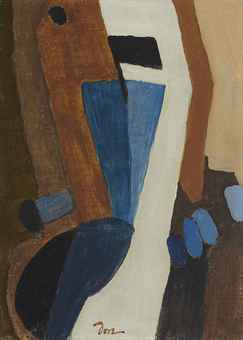
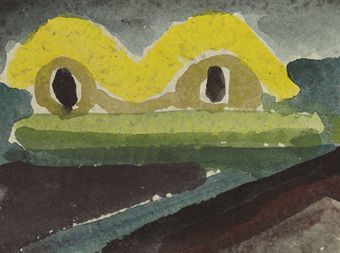
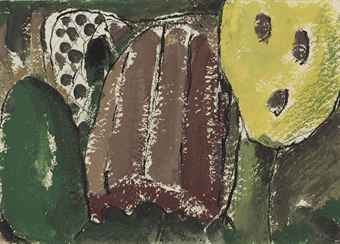
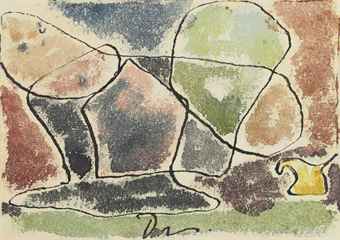
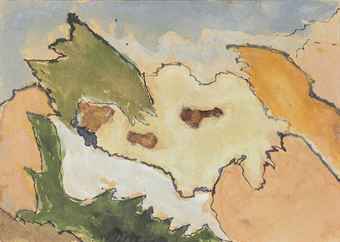
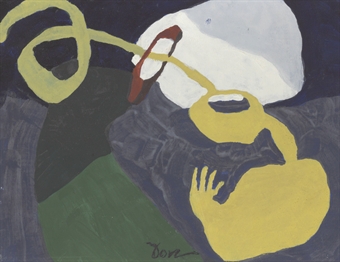
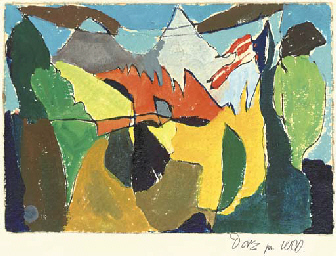
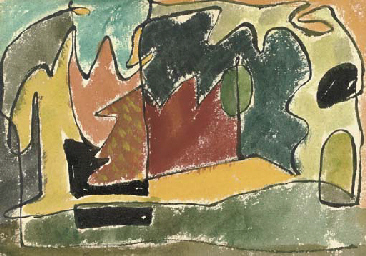
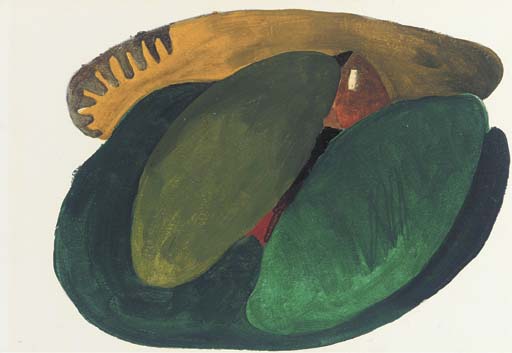
 Arthur Dove painted Arrangement est. $600/800,000) in 1944, two years before his death, during a period in which he was approaching his work with a new intensity and focus. Following a heart attack, Dove was diagnosed with a kidney disorder that left the artist housebound for the rest of his life. Ironically, this setback yielded the most fully-developed and forward-looking work of his career. Arrangement, like other works from this fruitful period, represents the culmination of Dove’s unique synthesis of nature and abstraction and comprises sculptural, biomorphic, three-dimensional and overlapping shapes. 
 

Sotheby's 2013


ARTHUR GARFIELD DOVE
1880 - 1946
RECTANGLES
Estimate  400,000 — 600,000


ARTHUR GARFIELD DOVE
1880 - 1946

LATTICE AND AWNING


LOT SOLD. 1,685,000 

Sotheby's 2012


ARTHUR DOVE
1880-1946
ABSTRACTION
LOT SOLD. 182,500


ARTHUR GARFIELD DOVE
1880 - 1946
TOWN SCRAPER


LOT SOLD. 1,258,500

Sotheby's 2007

ARTHUR DOVE
COLORED IN


LOT SOLD. 42,000 
 
Skinner 2014


'Arthur Garfield Dove (American, 1880-1946) 
Centerport XIII


Sold for: 
$6,888 

Skinner 2012


Christie's 2015


Christie's 2014
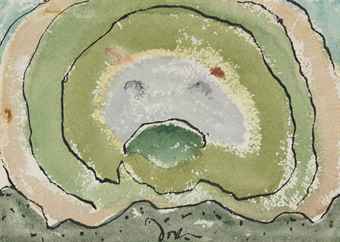


Happy Clam Shell 
PRICE REALIZED
$106,250


A Blue Jay Flew Up in a Tree 
PRICE REALIZED
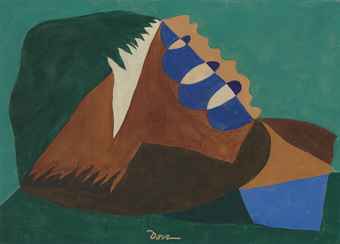
$81,250


Christie's 2013


PR.$30,000


Christie's 2010


Christie's 2008


ARTHUR DOVE (1880-1946)


  • ARTHUR GARFIELD DOVE (1880-1946) 
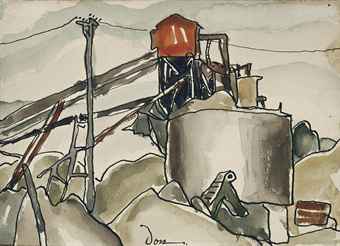
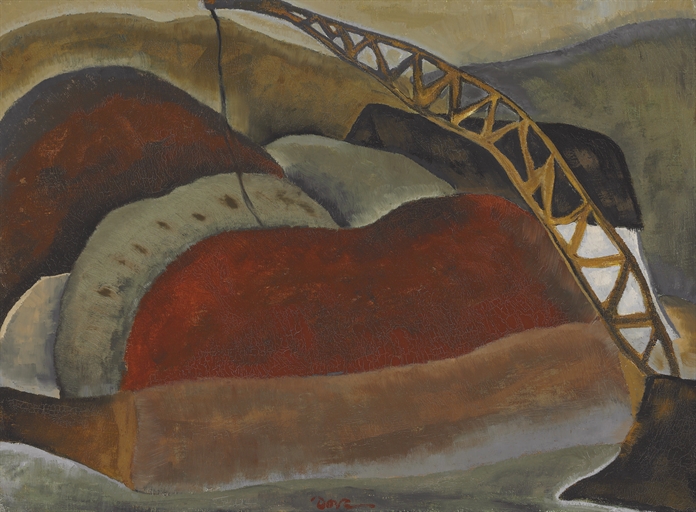
  • CINDER BARGE AND DERRICK 
  • PR.$902,500
  •  
  •  
  •  
  •  
  •  


Christie's 2004


Christie's 1999


More Christie's


Departure from Three Points 
PRICE REALIZED
$845,000
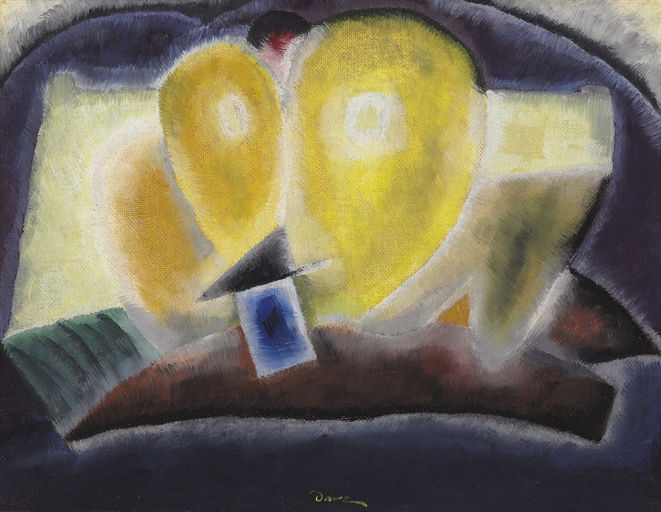


Sunday 
PRICE REALIZED
$578,500


Comments

Popular posts from this blog

FREDERIC EDWIN CHURCH at AUCTION

Biography Frederic Edwin Church was born in Hartford, Connecticut, on May 4, 1826, the only son of a wealthy businessman. Although his father hoped he would become a physician or enter the world of business, Church persisted in his early desire to be a painter. In 1842-1843 he studied in Hartford with Alexander H. Emmons (1816-1879), a local landscape and portrait painter, and Benjamin H. Coe (1799-after 1883), a well-known drawing instructor. In 1844 Church's father, at last resigned to his son's choice of a career, arranged through his friend, the art patron Daniel Wadsworth, two years of study with Thomas Cole. Church was thus the first pupil accepted by America's leading landscape painter, a distinction that immediately gave him an advantage over other aspiring painters of his generation. From the first, Church showed a remarkable talent for drawing and a strong inclination to paint in a crisp, tightly focused style. In 1845 he made his...

Genius and Ambition: The Royal Academy of Arts, London

The Royal Academy of Arts announces the most significant touring exhibition of its Collection in its 246-year history. Genius and Ambition: The Royal Academy of Arts, London opened 2 March 2014 at Bendigo Art Gallery, Australia.  Spanning 150 years of the Academy, the exhibition focuses on a key period of the RA Collection: the so-called ‘long nineteenth century’ from 1768-1918. Comprising 56 paintings, twenty drawings, nine prints, eight historic books, two photographs and two sculptures, the display will also tour to four venues in Japan, between August 2014 – April 2015. Several works in the exhibition have never travelled outside of the UK before, including  Sir Joshua Reynolds PRA’s Theory (1789-90), and Sir Ernest Waterlow RA’s The Banks of the River Loing (1903)   Further highlights of the exhibition include  JMW Turner RA’s Dolbadern Castle (1800),  John Constable RA’s Boat Passing a Lock (1826),  Henry Fuseli RA’s Thor battering the Midgard Serpent...

THOMAS HART BENTON at Auction III - Christie's, Doyle, Bonhams

Biography - Questroyal Fine Art, LLC, New York, New York By Amy Spencer Benton’s paintings were widely loved for their reassuring images of the American heartland during two World Wars and the Great Depression. I. Biography  Thomas Hart Benton is best known for his patriotic murals that heroically depict American life during the first half of the 20th century. Born into a prominent Mid-western family of politicians, Benton grew up moving between rural Missouri and the political arena of Washington D.C.. Rejecting his grooming as a future politician, Benton developed an interest in art at an early age. Despite this rebellion, over the course of Benton’s painting career, his outspoken comments, nationalistic views, and socially charged images, marked him as a politician’s son. At the peak of his career in the 1930s, Benton was a key member of the Regionalist movement along with fellow Midwestern artists, Grant Wood and John Steuart Curry. Thomas Hart Benton was born in ...