Lucas Cranach the Elder at Auction


Sotheby’s London 3rd Dec. 2014
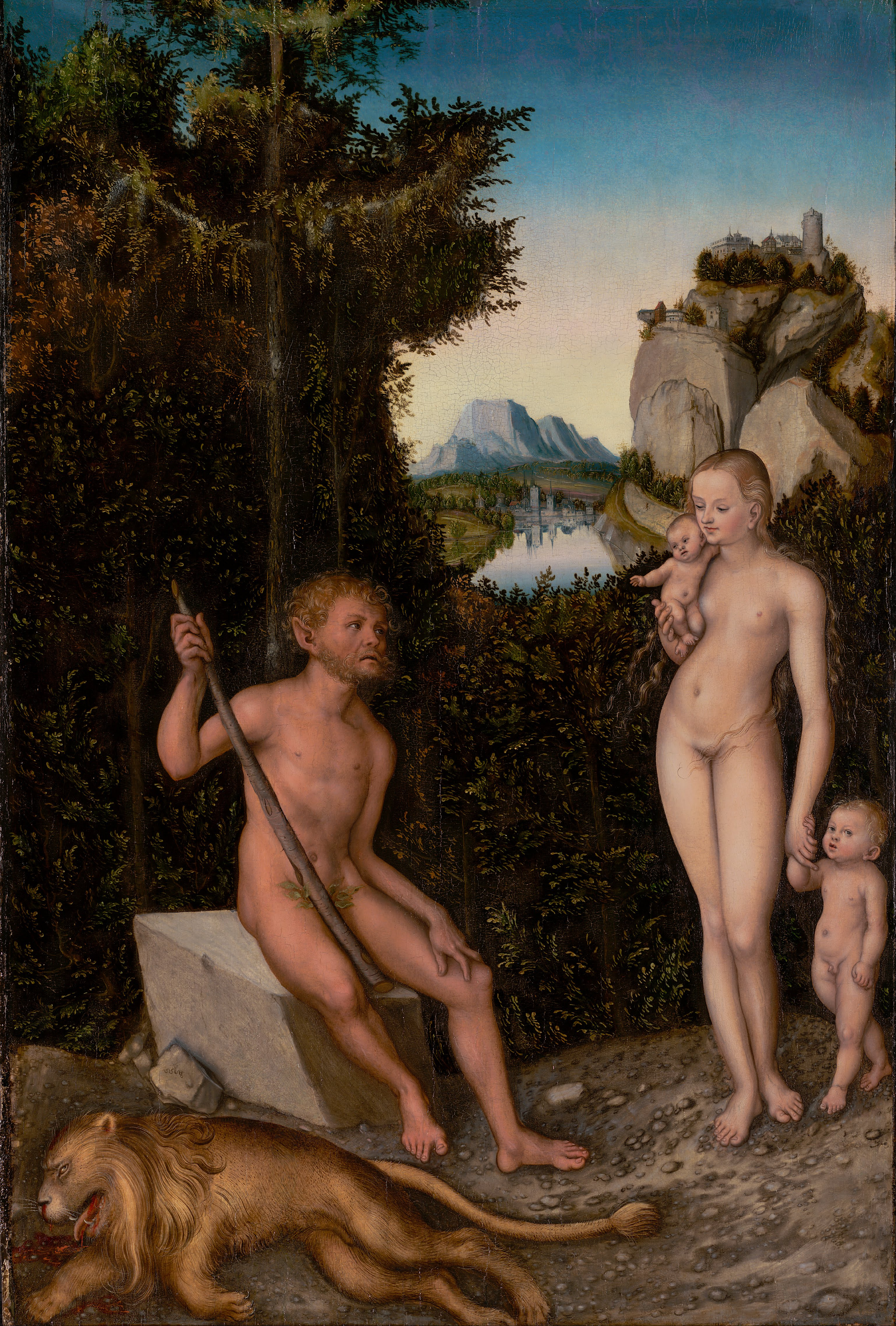


The sale will also present The Faun Family, a major work by Lucas Cranach the Elder (1472-1553). Not seen on the market for some 60 years, this composition, unique to the artist’s oeuvre, was painted in 1531, at the height of his career. It was commissioned no doubt by a member of the courtly circle in Wittenberg, where Cranach was in the employ of the Electors of Saxony. This outstanding work is remarkable for the precision with which every detail is rendered. It is part of a series of mythological depictions of wild people, forest dwellers or demigods. The subject had long fascinated the artist and culminated in a series of panel paintings from the second half of the 1520s onwards (lot 13, est. £1.2-1.8 million / €1,53-2.29 million / $1.94-2.9 million).


Sotheby's CONTEMPLATION OF THE DIVINE LONDON


LUCAS CRANACH THE ELDER


Christie's January 2014


The striking painting Law and Grace by Lucas Cranach I (Kronach 1472-1553 Weimar) and Lucas Cranach II (Wittenberg 1515-1586 Weimar) is among the most important images of the Protestant Reformation (illustrated right; estimate: $1,500,000-2,500,000). Painted in 1536, the panel illustrates Martin Luther's doctrine of justification by faith with explanatory passages from a German translation of the bible written on papers affixed to its lower and upper edges. With its vivid, jewel-toned palette, deep, panoramic landscapes, and expressive figures, Law and Grace exhibits all of the stylistic hallmarks that placed Lucas Cranach at the forefront of artistic innovation in 16th-century Europe.

Sotheby's OLD MASTER SALE LONDON


LUCAS CRANACH THE ELDER


LOT SOLD. 1,022,500 GBP (1,675,264 USD)
The highly refined technique of Lucas Cranach the Elder (1472-1553) can be admired in a portrayal of Lucretia, one of the artist’s favourite subjects. Dating from around 1525-27, this round panel is one of very few works painted on an almost miniature scale by the artist. Cranach’s masterful depictions of the female nude with their sophisticated sensuality have always been among the most coveted of his creations and this panel has the distinction of having belonged to one of the foremost collectors of the late 19th century, Count Grigory Stroganoff (1829 - 1910) (lot 3, est. £300,000-500,000/ €349,000-585,000/ $467,000-780,000.


Christie's December 2013


 A very impressive large panel Suffer the Little Children to Come unto Me, 1538 by Lucas Cranach (1472-1553) which is in beautiful condition (estimate: £250,000-350,000) t

Christie’s Old Master & British Paintings Evening Sale in London  2 July 2013 


Portrait of Albrecht von Brandenburg as Saint Jerome in a landscape by Lucas Cranach the Elder (1472-1553) is an icon of Northern Renaissance art (estimate: £1.5-2 million). The picture is rare surviving evidence of the relationship between Albrecht von Brandenburg, the supreme Catholic dignitary in Germany in the early decades of the 16th century, and Lucas Cranach the Elder, an artist often described as Martin Luther’s foremost propagandist. The story of this portrait brings together three titans of the Reformation whose inextricably entwined destinies shaped this period of European history. This painting is the only one of four surviving portraits of Albrecht in the guise of Saint Jerome painted by Cranach, to remain in private hands.


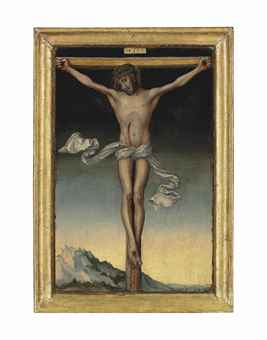
Christ on the Cross is a unique, intimate depiction of this subject by Lucas Cranach the Elder (1472-1553) (Pr.£1,137,075($1,729,491)). This poignant work seamlessly blends extreme pictorial refinement with a heightened sense of pathos.

Sotheby's 2013


LUCAS CRANACH THE ELDER
CHRIST AS MAN OF SORROWS

LOT SOLD. 302,500 USD


Sotheby's 2008


LUCAS CRANACH THE ELDER
HERCULES AND ANTAEUS


Comments

Popular posts from this blog

FREDERIC EDWIN CHURCH at AUCTION

Biography Frederic Edwin Church was born in Hartford, Connecticut, on May 4, 1826, the only son of a wealthy businessman. Although his father hoped he would become a physician or enter the world of business, Church persisted in his early desire to be a painter. In 1842-1843 he studied in Hartford with Alexander H. Emmons (1816-1879), a local landscape and portrait painter, and Benjamin H. Coe (1799-after 1883), a well-known drawing instructor. In 1844 Church's father, at last resigned to his son's choice of a career, arranged through his friend, the art patron Daniel Wadsworth, two years of study with Thomas Cole. Church was thus the first pupil accepted by America's leading landscape painter, a distinction that immediately gave him an advantage over other aspiring painters of his generation. From the first, Church showed a remarkable talent for drawing and a strong inclination to paint in a crisp, tightly focused style. In 1845 he made his...

THOMAS HART BENTON at Auction III - Christie's, Doyle, Bonhams

Biography - Questroyal Fine Art, LLC, New York, New York By Amy Spencer Benton’s paintings were widely loved for their reassuring images of the American heartland during two World Wars and the Great Depression. I. Biography  Thomas Hart Benton is best known for his patriotic murals that heroically depict American life during the first half of the 20th century. Born into a prominent Mid-western family of politicians, Benton grew up moving between rural Missouri and the political arena of Washington D.C.. Rejecting his grooming as a future politician, Benton developed an interest in art at an early age. Despite this rebellion, over the course of Benton’s painting career, his outspoken comments, nationalistic views, and socially charged images, marked him as a politician’s son. At the peak of his career in the 1930s, Benton was a key member of the Regionalist movement along with fellow Midwestern artists, Grant Wood and John Steuart Curry. Thomas Hart Benton was born in ...

Genius and Ambition: The Royal Academy of Arts, London

The Royal Academy of Arts announces the most significant touring exhibition of its Collection in its 246-year history. Genius and Ambition: The Royal Academy of Arts, London opened 2 March 2014 at Bendigo Art Gallery, Australia.  Spanning 150 years of the Academy, the exhibition focuses on a key period of the RA Collection: the so-called ‘long nineteenth century’ from 1768-1918. Comprising 56 paintings, twenty drawings, nine prints, eight historic books, two photographs and two sculptures, the display will also tour to four venues in Japan, between August 2014 – April 2015. Several works in the exhibition have never travelled outside of the UK before, including  Sir Joshua Reynolds PRA’s Theory (1789-90), and Sir Ernest Waterlow RA’s The Banks of the River Loing (1903)   Further highlights of the exhibition include  JMW Turner RA’s Dolbadern Castle (1800),  John Constable RA’s Boat Passing a Lock (1826),  Henry Fuseli RA’s Thor battering the Midgard Serpent...