November 8, 2013 to November 8, 2014 Parrish Art Museum 279 Montauk Highway Water Mill, NY 11976


William Merritt Chase was a much sought after portrait painter in Gilded Age America. The commissioned paintings of college presidents, society matrons, and captains of industry run well into the hundreds, but it is in the pictures of his family and students that we see his true art.
As a young man Chase left his native Indiana to attend classes in New York City at the National Academy of Design but stayed less than a year. His real training in art began in Munich at the Royal Academy, where he studied from 1872–1878, and in the picture galleries of the nearby Alte Pinakothek. There he absorbed the lessons of the great portrait painters of the past: the Dutchmen Rembrandt van Rijn and Frans Hals; the Flemish painters Peter Paul Rubens and Anthony van Dyck; and the Spanish masters Diego Velázquez and Francisco de Goya. Velázquez’s famous self-portrait in Las Meninas may well have been on Chase’s mind when he painted the

Twilight Portrait of the Artist six years later.

The Golden Lady is a portrait of one of his students during a class Chase led at the Prado in 1896.
Alice Dieudonnée Chase (1887–1971), his eldest child and the subject of three portraits in this gallery, was her father’s favorite model. When asked why, he noted, ”I suppose it is because she looks so much like her dear mother.” In these three works she is not only a willing participant but an active collaborator in the staging of the scene and the affection the artist feels is strongly present.
In the summer of 1889, William Merritt Chase and his family lived in Bensonhurst, Brooklyn, to escape the city’s summer heat. In
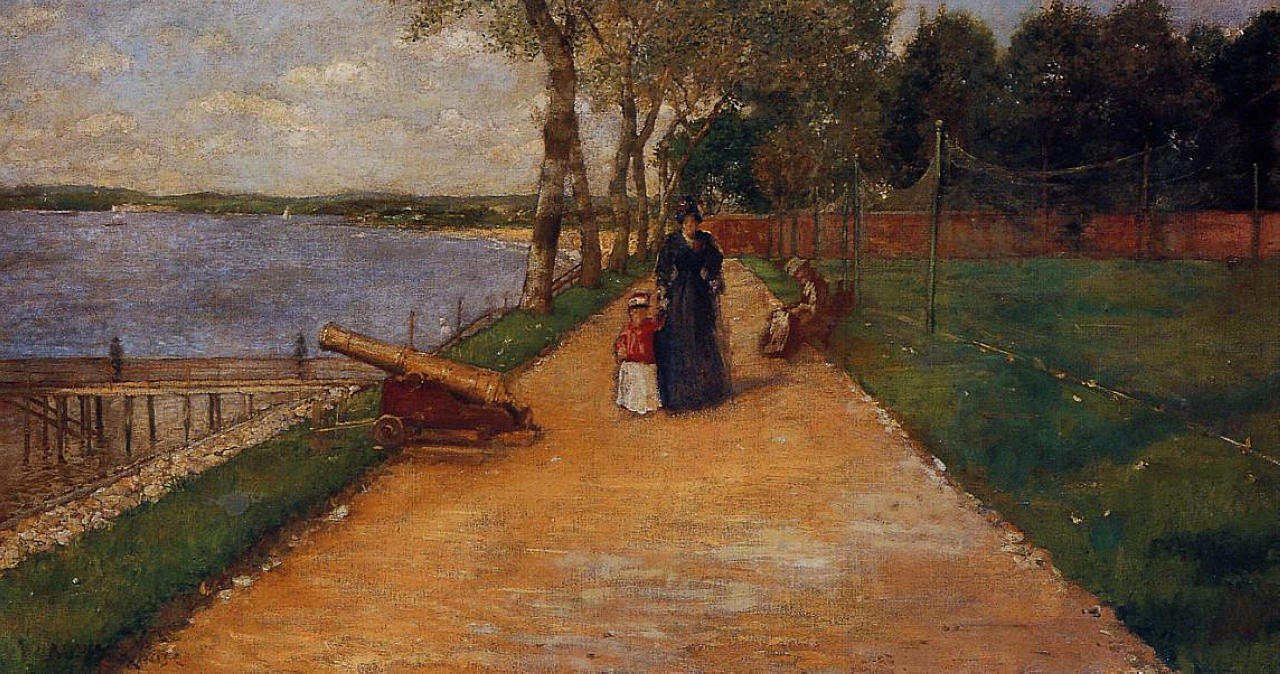
Bath Beach: A Sketch,
his wife Alice is seen walking with their first child, Alice Dieudonnée, along the promenade by the water, a scene modeled after the work of the many French Impressionists he had seen during his time in Europe.

William Merritt Chase (American, 1849-1916) . Portrait of a Girl in Red Embroidered Jacket, c. 1896. Oil on canvas, 25 3/8 x 18 ½ inches. Parrish Art Museum
In 1902, Chase appointed Robert Henri to teach with him at the New York School of Art (founded in 1896 as the Chase School of Art). The two artists, both well-known portraitists, were unified in their admiration for Hals, Velázquez, and Manet, yet five years later the younger artist’s progressive views led to a complete rupture. Chase’s old master brushwork and refined subjects contrasted with Henri’s modern portrayals of the grittier side of urban life. Two portraits painted during this period and now facing one another in the gallery—Chase’s of his daughter Alice and

Henri’s of his wife Linda—demonstrate the contrasts and similarities between these two colleagues, who together show the changing course of American art at the turn of the twentieth century.

Henri’s of his wife Linda—demonstrate the contrasts and similarities between these two colleagues, who together show the changing course of American art at the turn of the twentieth century.
Also in the Museum's Collection:


John Sloan (American, 1871–1951) Hill, Main Street, Gloucester, ca. 1916. Oil on canvas, 25¾ x 39⅞ inches. Parrish Art Museum, Littlejohn Collection,
Comments
Post a Comment